h y b r i d - b a n k n o t e s


view all my other world banknotes alphabetically

| a | b | c | d | e | f | g | h | i | j | k | l | m | n | o | p | q | r | s | t | u | v | w | x | y | z |

below are countries that have issued hybrid banknotes since 1995

| 1995 | canada | 2005 | bulgaria | 2006 | kazakhstan | 2007 | fiji | latvia | qatar | 2008 | swaziland | mauritania | tonga | samoa | bermuda | 2009 | papua new guinea | jamaica | 2010 | mongolia | tajikistan | oman | sudan | 2011 | gibraltar | united arab emirates | 2012 | morocco | suriname | 2013 | bhutan | solomon islands | iceland | russia | 2014 | scotland - the royal bank of scotland | madagascar | iraq | 2015 | central african states | burundi | european union | lesotho | 2016 | switzerland | seychelles | lebanon | 2017 | the bahamas | 2018 | malaysia | south africa | armenia | 2019 | poland | cambodia | zimbabwe | comoros | 2020 | ???? | 2021 | ???? | 2022 | algeria | 2023 | ???? | 2024 | ???? | 2025 | namibia | 2026 | ???? | ????
...As the heading goes, this site is dedicated to Hybrid banknotes only. This is a very specialised area of collections and in general, Hybrid banknotes are usually printed on high denominations or the top end of currency of a country. However despite saying this, there are few exceptions where Hybrid banknotes are printed on an entire series. I believe there are less than 300 pieces of Hybrid banknotes issued so far (including reprints), and apart from one or two pieces, the rest are still obtainable to collectors.


"there are no borrowed scans used here. all notes displaying here are mine"

any comments are always welcome and all comments are subject to approval, usually within 24/48 hours

Showing posts with label European Union. Show all posts

11 April, 2026

...European Union - 200 Euro Dated 2019 Hybrid s. Mario Draghi Print

European Union
(Austria, Belgium, Bulgaria*, Croatia, Cyprus, Czech Republic*, Denmark*, Estonia, Finland, France, Germany, Greece, Hungary*, Ireland, Italy, Latvia, Lithuania, Luxembourg, Malta, The Netherlands, Poland*, Portugal, Romania*, Slovakia, Slovenia, Spain and Sweden*.)

European Central Bank (est. 1998)
Currency : Euro (EUR €)
 
Below is a 200 euro hybrid banknote printed with the year date of 2019. This note bears the signature of Mario Draghi, who was the President of the European Central Bank from 01.11.2011 to 31.10.2019. Since then he has been replaced by Christine Madeleine Odette Lagarde.
 
The design for this 200 euro is very similar to those first issued back in 2002. However, this 2019 note is printed on hybrid material. This is the first hybrid note for this denomination. Whilst this is the second largest denomination circulating in Europe, the European Central Bank has ceased issuing the 500 euro banknote since the end of 2018. The reason for this is that the central bank's suspicious that the 500 euro notes have been widely used for illegal purposes.
 
This 200 euro was reportedly released on 28.05.2019. It is believed that one three notes are issued with the prefixes of N (Austria), S (Italy) and U (France). Here, I have posted one with the letter 'S'.
 
Two Hundred Euro 


Front - It depicts arches and doorways in Art Nouveau style of the 19th and 20th centuries. These arches and doorways are usually made of glass and iron with decorative arts.

Signature - Mario Draghi (tenure 2011-2019)
Watermarks - portrait of Europe and electrotype 200
Dimensions - 154.5mm x 78mm

Back - An image of a Cantilever bridge. This is just an artist impression of such a bridge as there is no such real bridge that is actually located within the Eurozone. Below the bridge is the map of Europe showing all it's 28 EU members, including its formal member, the United Kingdom. Also printed are the  tiny maps of overseas territories occupied by the Portuguese, the French and the Spanish, located in the North Atlantic Ocean, Caribbean, South America and the Indian Ocean. Twelve five-point stars in a circular position are also printed around the map of Europe. These 12 stars symbolise or represent all the EU members.


Azores (Pt) - 3 tiny islands;
Guadeloupe (Fr); Martinique (Fr), Madeira (Pt), Reunion (Fr) - 4 tiny islands;
French Guiana (Fr) in South America; and
Canary Islands - La Palma, Tenerife, Lanzarote, Gran Canaria, Fuerteventura (all Sp) - 5 tiny islands.
 
Note * - countries that are yet to adopt the Euro currency.

01 July, 2020

...European Union - 100 Euro Hybrid Dated 2019, s. Mario Draghi Prints

European Union
(Austria, Belgium, Bulgaria, Croatia, Cyprus, Czech Republic, Denmark, Estonia, Finland, France, Germany, Greece, Hungary, Ireland, Italy, Latvia, Lithuania, Luxembourg, Malta, the Netherlands, Poland, Portugal, Romania, Slovakia, Slovenia, Spain and Sweden.)

European Central Bank
Currency : Euro (EUR) since 2002

The European Central Bank commented printing Hybrid banknotes with the first release of the €20 dated 2015. In total, eleven prints were issued. Posted here are the latest series of 100 euro currency printed with the year date of 2019. The European Central Bank (ECB) acting as the central bank of the 19 European Union countries which have adopted the euro as their main currency and these countries are - Austria, Belgium, Cyprus, Estonia, Finland, France, Germany, Greece, Ireland, Italy, Latvia, Lithuania, Luxembourg, Malta, the Netherlands, Portugal, Slovakia, Slovenia and Spain. There are 27 members in the European Union, and the countries that have not adopted the euro as its national currency are - Bulgaria, Croatia, Czech Republic, Denmark, Hungary, Poland, Romania and Sweden. Other nations/territories in Europe also using the euro are Andorra, Monaco, San Marino, Vatican City and Akrotiri and Dhekelia (UK).

Outside mainland Europe, the euro is also the official currency of the following nations/territories;-

America - Clipperton Island (if you can find anything to buy here), French Guiana, Miquelon, Saint Barthelemy, Saint Martin and Saint Pierre;
Africa - French Southern and Antarctic Lands (I wonder if they have any shops here?), Mayotte and the Reunion.

The Euro was officially named in 1995, and introduced as an accounting currency in 1999. In 2002, the euro physically entered into circulation.

It appears that only 6 varieties are printed for this 100 euro series and these are with letter prefixes of E, N, R, S, U and V, and here I have posted 4 of the notes. I am missing those with prefixes E and S.

The designs for the 100 euro are:-
Front - Haroque and Rokoko architecture (windows and doorways), 12 Five-Point stars in the shape of a circle, a flag of the EU;
Back - bridge of Baroque architecture, 12 stars over the map of Europe, overseas territories of France, Portugal and Spain.

The windows and doorways on the front symbolised the spirit of openness and cooperation. The bridge on the back representing the communication between the people of Europe and also with the rest of the world. All the designs of stylish architecture and bridges from various periods in Europe's history printed on the euros do not represent any actual existing monuments or bridges.

Signature : Mario Draghi (President of ECB - no title or position printed)
Dimensions : 148mm x 77mm

One Hundred Euro
Dated 2019, Prefix NA, Code N004H1
Reverse, Imprinter - Oesterreichusche Banknoten und Sicherheitsdruck GmbH

One Hundred Euro
Dated 2019, Prefix RB, Code R004F4
Reverse, Imprinter - Bundesdruckerei, Berlin

One Hundred Euro
Dated 2019, Prefix UC, Code U002E3
Reverse, Imprinter - Banque de France, Chamalieres

One Hundred Euro (Imprinter - Fabrica Nacional de Moneda y Timbre, Madrid)
Dated 2019, Prefix VA, Code V004C4
Reverse, Imprinter - Fabrica Nacional de Moneda y Timbre, Madrid

One Hundred Euro (imprinter - Francois Charles Oberthur, Fiduciaire Chantepie, France)
Dated 2019, printer code E010B2

Reverse, Imprinter - Francois Charles Oberthur, Fiduciaire Chantepie for Slovakia

One Hundred Euro (Imprinter - Banca d'Italia, Rome, Italy)
Dated 2019, printer code S005A5

Reverse, Imprinter - Banca d'talia, Rome 

Have you wondered which are the overseas territories printed on the back of the note? Below, I have listed the names of all the islands and territories, starting from the top and left to right;-

Azores (Pt) - 3 tiny islands;
Guadeloupe (Fr); Martinique (Fr), Madeira (Pt), Reunion (Fr) - 4 tiny islands;
French Guiana (Fr) in South America; and
Canary Islands - La Palma, Tenerife, Lanzarote, Gran Canaria, Fuerteventura (all Sp) - 5 tiny islands.

Footnote➽
The Euro was officially named in 1995, and introduced as an accounting currency in 1999. In 2002, the euro physically entered into circulation.

Until 31.01.2020, there were 28 EU members. The United Kingdom officially withdrew its membership (Brexit) on 31.01.2020 following a referendum held in June 2016 with 51.9% voted to leave the EU, thus leaving with only 27 members left. The Euro is the sole currency of 19 EU member states, namely Austria, Belgium, Cyprus, Estonia, Finland, France, Germany, Greece, Ireland, Italy, Latvia, Lithuania, Luxembourg, Malta, the Netherlands, Portugal, Slovakia, Slovenia, and Spain. The United Kingdom officially joined the EU on 01.01.1973. In 1975, a referendum was held to gauge the support of Britain to remain as part of the EU. The vote was 67.23% in favour of the "Yes" votes. Almost 26 million of the population voted in this referendum. It was reported after the 2016 referendum that many of those who voted in favour back in 1975 have changed their mind and voted "No" in 2016. I do not know how true this is as I do not have the statistics to back me up. If this is correct, then the 2016 referendum was basically between the young and the not so young.

In addition to these 19 members, the Euro is also the official currency of the following nations/territories: -

Europe - Andorra, Monaco, San Marino, Vatican City and Akrotiri and Dhekelia (UK);
America - French Guiana, Clipperton Island (if you can find anything to buy here), Miquelon, Saint Barthelemy, Saint Martin and Saint Pierre;
Africa - French Southern and Antarctic Lands (are there any shops here?) and the Reunion Island.

The following countries have applied to join the EU and it's waiting for approval;
Turkey (1987), North Macedonia (2004), Montenegro (2008), Albania (2009), and Serbia (2009).

And finally, these 4 notes posted came from a very good collector friend from Slovakia who was very kind and generous in assisting me in my hobby. You know who you are and I thank you for your assistance. I have not mentioned your name to protect your privacy. Once again, thank you for your assistance, mate.

01 November, 2017

...European Union - 50 Euro 2017 Hybrid Notes

European Union
(Austria, Belgium, Bulgaria, Croatia, Cyprus, Czech Republic, Denmark, Estonia, Finland, France, Germany, Greece, Hungary, Ireland, Italy, Latvia, Lithuania, Luxembourg, Malta, the Netherlands, Poland, Portugal, Romania, Slovakia, Slovenia, Spain, Sweden and United Kingdom [Brexit 01.02.2020])

European Central Bank (est. 1998)
Currency - Euro (EUR)
 
Note: Missing the Y prefix (Greece)
 
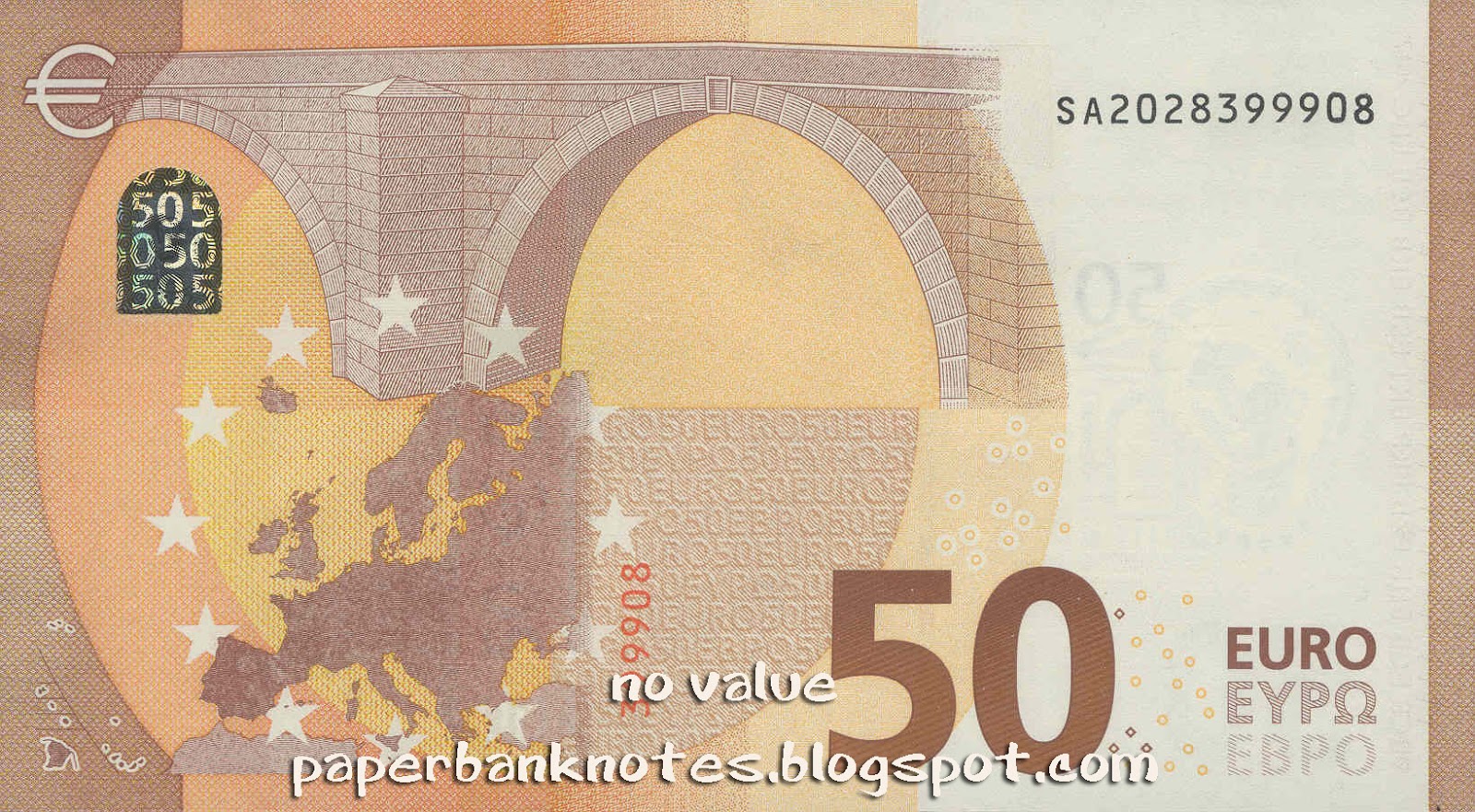
These are the fourth issue of the 2013 series bearing the signature of Mario Draghi, President of the European Central Bank. These notes were released on 04.04.2017, and like the previous 20, these €50 banknotes are also printed with Hybrid materials, including a transparent see-through arch window on the strip located on the right hand side of the note. At this stage, the following prefixes have been sighted - E, M, P, R, S, U, V, W, Y & Z. If these are the only prefixes issued, then here I have a complete set posted below. It's not easy to find a full set.


Fifty Euro (E)

Dated 2017, P23e
Reverse - Francois-Charles Oberthur, Chantepie France
Fifty Euro (M)
Dated 2017, P23m
Reverse - Valora-Banco de Portugal, Carregado Portugal
Fifty Euro (P)
Dated 2017, P23p, Code P005D4
Reverse - Johan Enschede Security Print, Haarlem, The Netherlands
Fifty Euro (R)
Dated 2017, P23r, Code RoioB2
Reverse - Bundesdruckerei, Berlin Germany
Fifty Euro (S)
Dated 2017, P23s
Reverse - Banca d'Italia, Rome Italy
Fifty Euro (U)
Dated 2017, P23u
Reverse - Banque de France, Chamalieres France
Fifty Euro (V)
Dated 2017, P23v
Reverse - Fabrica Nacional de Moneda y Timbre, Madrid Spain
Fifty Euro (W)
Dated 2017, P23w
Reverse - Giesecke & Devrient, Leipzip Germany

Fifty Euro (Z)
Dated 2017, P23z
Reverse - Banque Nationale de Belgique

Fifty Euro (Y)

2017

Y prefix


02 February, 2016

.European Union - 20 Euro 2015 Hybrid Complete Set

Twenty Euro (Hybrid) All Dated 2015. Reference # P22

Updated 15.03.2020
This is the final of the 20 euro Hybrid note printed by the Central Bank of Ireland with prefix T. The note was printed by the Central Bank of Ireland printing work facility situated in Sandyford, Co Dublin. It is believed that this facility has ceased printing the euro currency since mid 2018 and going forward, no more euro banknotes will be printed with the letter prefix T. One of the main reasons for not printing euros anymore was due to high cost related to the manufacturing of the banknotes. The Irish Printworks mainly printed the €10 and €20 denominations. In all, there are 11 printers for the 20 euro and the letter prefixes are E, M, N, R, S, T, U, V, W, X & Z.

Twenty Euro
Dated 2015, Central Bank of Ireland
Prefix T, Code T006A4

Originally posted on 02.02.2016
Austria (printer code N008E1)
Prefix NA, P22n
Printer; Oesterreichusche Banknoten und Sicherheitsdruck GmbH, Vienna
France (printer code E001G2)
Prefix EA, P22e
Printer: Francois Charles Oberthur, Fiduciaire Chantepie
France (printer code U003D2)
Prefix UB, P22u
Printer: Banque de France, Chamalieres
Belgium (printer code Z001I1)
Prefix ZA, P22z
Printer: Banque Nationale de Belgique, Belgium
Germany (printer code R007H1)
Prefix RA, P22r
Printer; Bundesdruckerei, Berlin
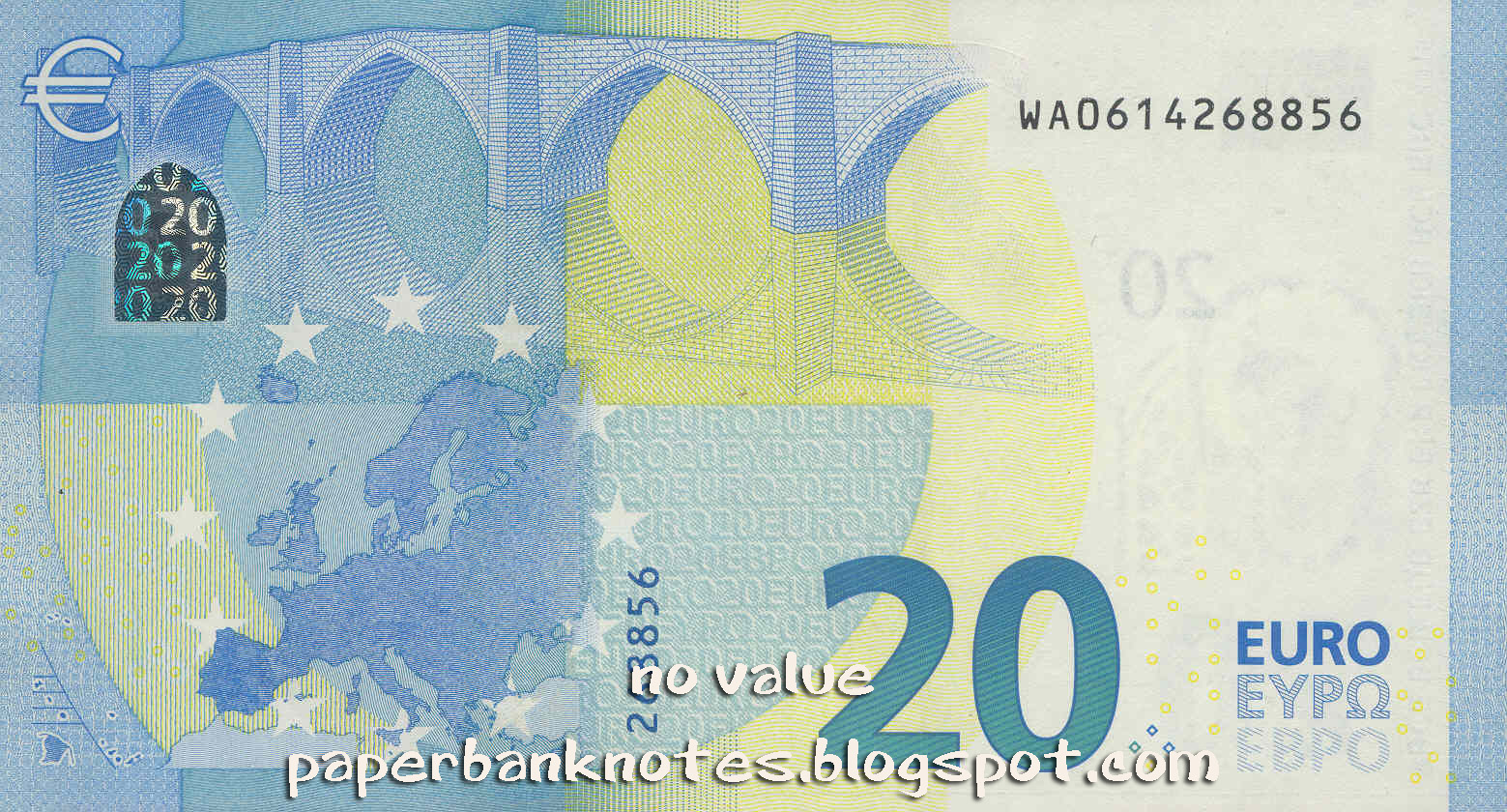
Germany (printer code W001B5)
Prefix WA, P22w
Printer; Giesecke & Devirent, Leipzig
Germany (printer code X001H4)
Prefix XA, P22x
Printer: Giesecke & Devirent, Munich
Italy (printer code S004I6)
Prefix SA, P22s
Printer: Banca d'Italia, Rome Italy
Portugal (printer code M001B4)
Prefix MC, P22m
Printer; Valora S.A., Carrregodo
Spain (printer code V004G3)
Prefix VA, P22v
Printer; Fabrica Nacional de Moneda y Timbre, Madrid
European Union - These are the latest 20 Euro printed and issued in late 2015 (25.11.2015). This is also the first Euro denomination printed on Hybrid material with a polymer strip approximately 15mm wide added to the right hand side of the note. The strip also provides a transparent arch window showing a woman's head (portrait of Europa) and the denomination value of 20 (Euro). The transparent window is quite hard to see on the front but is very obvious on the back, as you can see from the scans. As this is a new series, the themes are still the same as previous issues ie flag of EU, arches, windows and bridges on the back with the map of Europe and its overseas territories in South America and the Indian Ocean. Unlike many other national currencies, the design of the Euro is quite unique as there are very limited texts/alphabets printed on the notes. The only names/words printed are the European Central Bank name in alphabets (initials) and they are BCE (France, Italy, Portugal, Romania, Spain); ECB (Czech Republic, Denmark, The Netherlands, United Kingdom, Latvia, Lithuania, Slovakia, Slovenia, Sweden); ЕЦБ (Bulgaria); EZB (Germany); EKP (Estonia, Finland); EKT (Greece); EKB (Hungary); BĊE (Malta) and EBC (Poland). The only full word printed is the currency name "Ëuro" in English, Greek and Bulgarian. I believe the currency name was only first adopted in the mid 90s before even the first physical Euro (both coins and banknotes) were even issued. There are no other inscriptions imprinted on the notes except the imprinter codes and serial numbers. One criticism that I have on the design is the map of Europe. If they have left out the map of Turkey with a lighter colour, then they should also do the same on countries like Iceland, Norway, Switzerland, few countries in the Balkan States, part of Russia, Belarus and Ukraine, which are not members of the EU community. In all, there are ten prints so far sighted. As you can see, I am still missing one print. Each note is also printed with a printer code which consists of 6 letters/digits i.e. A001B2. The first letter (A) representing the printer. The next 3 digits (001) refer to the printing plate no and the next letter (B) and digit (2) are referring to the roll and column respectively of the plate. It is not sure if other printers/prefixes are also printed by Ireland or Greece etc. The signature on the note belongs to the President of the European Central Bank (ECB), Mario Draghi, an Italian Economist and former Governor of Banca d'Italia. As the Euro currency is still relatively strong, collecting a full set can be financially challenging but not impossible as they are plenty around on offer. All you have to do is to pick one with the right price. If you can find one seller with all the ten notes on offer, you would save heaps on the delivery charges.